What counts as a household supply?
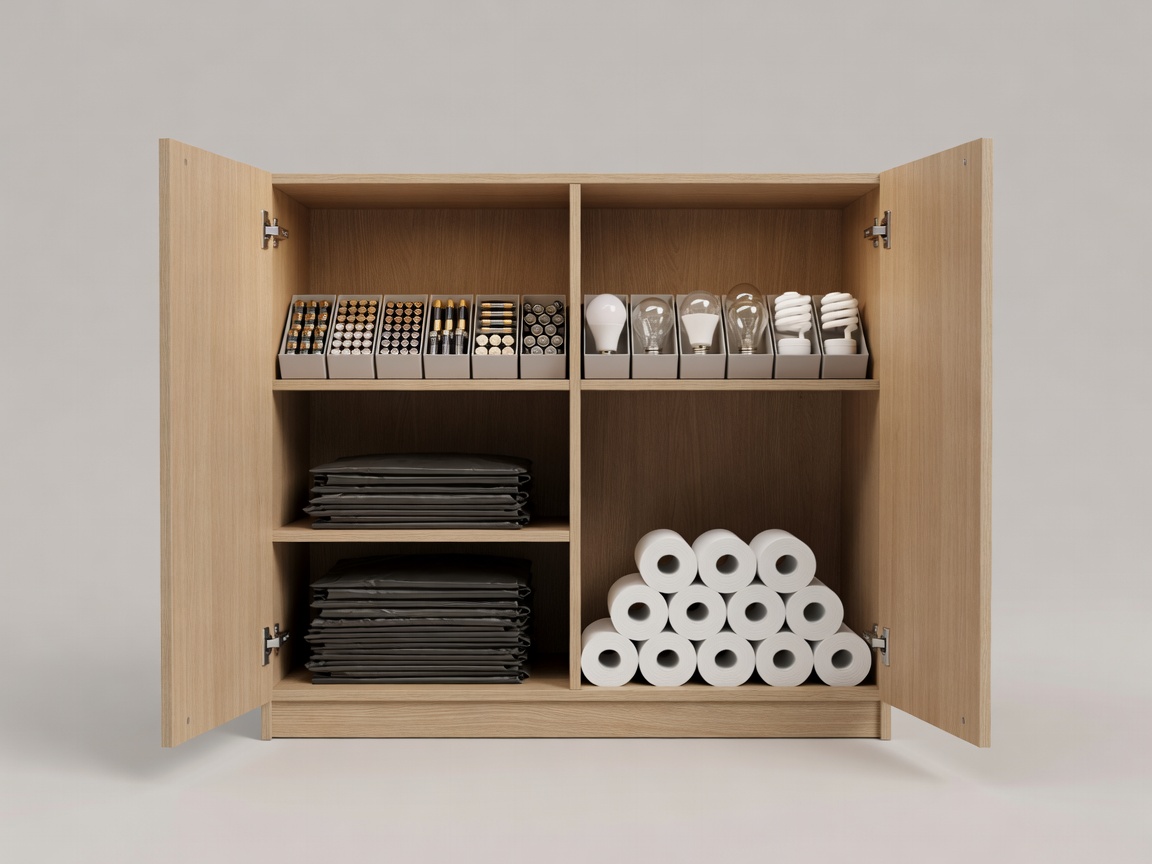
Supplies are the consumables that keep a home running: cleaning products, paper goods, bags and wraps, batteries, bulbs, first-aid basics, pet food and dry pantry staples. They share three traits. They run out, they are often bought in multiples, and they tend to scatter. A cupboard of "useful things" is usually a sign that supplies have no specific address.
Store at the point of use
The simplest rule is to store each supply where you use it, then keep any bulk spares in one central place. Bin bags belong in the bottom of the kitchen bin cupboard. Toilet rolls belong in or next to the bathroom. Bulbs and batteries can share a small labelled bin near the fuse box or in the utility room. Only the overflow goes to a central stock shelf.
This split matters because daily use and restocking are separate routines. Point-of-use storage serves the person who needs a new roll right now. Central stock serves the person writing the shopping list on Saturday morning. When both live in one place, one routine always gets in the way of the other.
Reach bands: put effort where it belongs
| Height | Store here | Why |
|---|---|---|
| Above head height | Spare stock, rarely used items | Visited only when restocking |
| Eye to hip | Everyday supplies, opened packs | No bending or stretching |
| Knee to floor | Heavy bulk: detergent, pet food, water | Safer to lift from low down |
Children and older relatives may have different reach. If someone in the household is expected to fetch an item, store it where they can reach it without a step stool.
One open, one spare
For most supplies, the item in use plus one spare is plenty. When you open the spare, add it to the list. Large families or rural households far from shops may need two spares, but set the number deliberately and write it on the shelf label. A shelf label reading "Dishwasher tablets: 1 spare" removes a surprising amount of guesswork.
Bulk buying can save money, but only if the stock has a home. If a multipack has nowhere to go, it ends up in a hallway or on the garage floor, and the saving quietly disappears into clutter and duplicate purchases.
A pantry that stays legible
Whether it is a walk-in larder or two kitchen cupboards, a pantry works when you can see what you have and what to use first. Group food by how you cook, such as breakfast, baking, tins and sauces, rather than by packaging type. Put newer purchases behind older ones so the first item you grab is the one closest to its date.
In the UK, the Food Standards Agency distinguishes between "use by" dates, which relate to safety, and "best before" dates, which relate to quality. Dry goods past their best before date may still be fine to eat, while foods past their use by date should not be eaten. Keep dry goods in a cool, dry place away from the oven and direct sunlight.
Decanting into clear jars looks tidy but adds a task. Do it for staples you use often, such as rice, pasta and oats, and label the jar with the product and its date. Leave everything else in its original packaging, which carries cooking instructions and allergen information.
Restock routine
- Keep the shopping list where supplies are stored
- Add an item the moment you open the spare
- Rotate pantry stock as you unpack
- Check the central stock shelf once a month
- Donate unopened duplicates you will not use in time